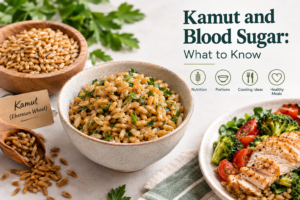
If you are trying to make more thoughtful choices about carbohydrates, you may feel like brown rice and oatmeal are the only grains worth eating.
They are certainly nutritious options, but they are not the only choices.
Kamut, also known as Khorasan wheat, is an ancient type of wheat with large golden-colored grains, a firm texture, and a slightly nutty flavor. It has become popular among people who want to try different whole-grain foods.
But what about Kamut and blood sugar?
Can Kamut actually help keep blood sugar more stable?
The answer is more complicated than some health headlines suggest.
Kamut is still a carbohydrate-containing grain. However, whole-grain foods can provide fiber and other nutrients, and the way you build the rest of the meal can also affect how your body responds to carbohydrates. The CDC recommends paying attention to both the type and amount of carbohydrate and using balanced meals that include vegetables and protein foods.
So rather than thinking of Kamut as a “miracle grain,” it may be more useful to understand what it is, what the research actually shows, and how you can include it in a balanced meal.
What Is Kamut?
Kamut is commonly used to refer to Khorasan wheat, an ancient type of wheat.
The grains are larger than many common wheat kernels and have a golden color. When cooked, they have a firm, chewy texture and a mild, nutty flavor.
KAMUT® brand wheat is a specific branded form of Khorasan wheat. Whole-grain KAMUT® wheat provides carbohydrates along with protein, fiber, and minerals.
Kamut can be used in several ways:
- Grain bowls
- Salads
- Soups
- Side dishes
- Mixed-grain meals
- Pasta
- Bread and other baked foods
If you are new to Kamut, you do not have to replace your usual grains completely. Starting with a small amount can make it easier to get used to the texture.
Is Kamut Good for Blood Sugar?
Kamut should not be viewed as a food that automatically lowers blood sugar.
Like other wheat-based grains, Kamut contains carbohydrates, so it can raise blood glucose after eating.
However, there has been some research specifically on Khorasan wheat.
One randomized crossover trial involving 21 people with type 2 diabetes compared products made from ancient Khorasan wheat with products made from modern wheat. The researchers reported some improvements in glucose and insulin-related measures during the Khorasan wheat phase, although the study was small and used several different Khorasan wheat products rather than simply cooked Kamut grains.
Another study in 30 healthy adults found that a 16-week diet using whole-grain KAMUT® Khorasan wheat products was associated with a decrease in insulin, but it did not show a significant reduction in fasting glycemia.
These findings are interesting, but they do not prove that eating Kamut will lower blood sugar in everyone.
That is an important distinction.
Kamut and the Glycemic Index
You may see websites claiming that Kamut has a glycemic index of around 40 and therefore raises blood sugar much more slowly than brown rice.
I would be careful with a specific number like that.
The glycemic response of a food can vary depending on the grain, processing, cooking method, serving size, and what else is eaten with it.
Research on Khorasan wheat products also does not give us a simple answer. For example, a study comparing pasta made from different wheat varieties found that the Khorasan pasta did not consistently produce the lowest glucose response among the varieties tested.
So I would not use a single GI number to decide whether Kamut is “good” or “bad” for blood sugar.
A better approach is to look at the whole meal.
For example:
A large bowl of Kamut by itself
is different from:
A moderate portion of Kamut + vegetables + eggs or fish
The second meal contains a wider variety of nutrients and may be more balanced.
Does Kamut Have Fiber?
Yes, whole-grain Kamut can provide dietary fiber.
Fiber is important because your body does not digest it in the same way as sugars and starches. The CDC notes that fiber can support blood sugar management and digestive health and recommends whole grains, vegetables, fruits, legumes, nuts, and seeds as sources of fiber.
KAMUT® brand wheat lists about 10.5 grams of fiber per 100 grams of the grain, although the amount you actually get depends on the product and serving size.
This is one reason it is important to check the Nutrition Facts label rather than assuming that every food containing the word “Kamut” has the same nutritional profile.
A whole-grain Kamut product and a highly processed Kamut-based product are not necessarily nutritionally identical.
What About Selenium in Kamut?
Kamut is also known for providing minerals, including selenium.
Selenium is an essential mineral involved in several normal functions in the body, including antioxidant defense and thyroid function.
Some research comparing Khorasan wheat with modern wheat has found differences in mineral composition, including selenium. However, the amount can vary depending on growing conditions and the specific grain.
This is why I would avoid calling selenium a “blood vessel cleaner.”
Selenium is an important nutrient, but eating a selenium-containing grain does not mean that it cleans your arteries or reverses blood-vessel damage.
It is more accurate to talk about the nutrient and its normal role than to turn it into a medical claim.
How Kamut May Fit Into a Blood-Sugar-Conscious Diet
You do not necessarily need to eliminate grains if you are watching your blood sugar.
Instead, pay attention to portion size, food quality, and the rest of the meal.
The CDC recommends a meal pattern that includes non-starchy vegetables, protein foods, and carbohydrate foods. Its plate method uses about half the plate for non-starchy vegetables, one quarter for protein, and one quarter for carbohydrate foods.
For example:
Kamut + grilled chicken + broccoli
or
Kamut + eggs + spinach + tomatoes
or
Kamut + salmon + roasted vegetables
These meals make Kamut one part of the meal rather than the entire meal.
For more practical food ideas, see 4 Foods for Better Blood Sugar Control.
How Much Kamut Should You Eat?
There is no single Kamut portion that is right for everyone.
Your carbohydrate needs can depend on your overall diet, activity level, health conditions, medications, and individual blood glucose response.
Instead of filling most of your plate with Kamut, you can use it as the carbohydrate portion of a balanced meal.
For example:
½ plate: non-starchy vegetables
¼ plate: protein
¼ plate: Kamut or another carbohydrate food
This is based on the CDC plate method and can be used as a starting point rather than a strict rule.
If you have diabetes and need specific carbohydrate targets, your healthcare professional or registered dietitian can help determine an amount that fits your individual needs.
Easy Ways to Eat Kamut
Kamut does not have to be difficult to prepare or use.
1. Kamut With Vegetables
Cooked Kamut can be mixed with vegetables such as:
- Broccoli
- Spinach
- Mushrooms
- Bell peppers
- Tomatoes
- Cucumber
Add eggs, tofu, chicken, fish, or another protein source to make the meal more complete.
2. Kamut Grain Bowl
Try:
Cooked Kamut + cucumber + tomatoes + leafy greens + grilled chicken
Add a small amount of olive oil and lemon juice for flavor.
3. Kamut With Rice
If the chewy texture of Kamut is new to you, try mixing a small amount with your regular rice.
This can be an easier way to introduce it without completely changing your usual meal.
4. Savory Kamut Breakfast
Kamut does not have to be a sweet breakfast.
Try:
Cooked Kamut + egg + spinach + mushrooms
You can add a small amount of avocado if you enjoy it.
5. Kamut in Soup
Cooked Kamut can also be added to vegetable or chicken soup.
The firm texture can make a simple soup more substantial.
How to Choose Kamut
When buying Kamut, look beyond the name on the front of the package.
Check the Nutrition Facts label and ingredient list, especially if you are buying Kamut bread, pasta, flour, crackers, or another processed product.
Look for:
- Whole-grain Khorasan wheat when appropriate
- Fiber content
- Total carbohydrates
- Added sugar
- Sodium
- Serving size
- Other ingredients
The word “Kamut” on the package does not automatically mean that the product is a low-carbohydrate or low-sugar food.
For someone watching blood sugar, the Nutrition Facts label is more useful than the marketing words on the front of the package.
Kamut vs. Brown Rice
Kamut and brown rice are both carbohydrate-containing grain choices, but they have different textures, flavors, and nutritional profiles.
| Kamut | Brown Rice | |
|---|---|---|
| Type | Ancient wheat | Whole-grain rice |
| Texture | Firm and chewy | Chewy |
| Flavor | Mild and nutty | Mild and slightly nutty |
| Contains carbohydrates | Yes | Yes |
| Provides fiber | Yes, especially as a whole grain | Yes |
| Gluten | Contains gluten | Naturally gluten-free |
| Common uses | Grain bowls, salads, soups | Rice bowls, side dishes, soups |
There is no need to decide that one is universally better.
Your choice can depend on your dietary needs, preferences, portion size, and how the grain fits into your overall meal.
Kamut vs. Oatmeal for Blood Sugar
Kamut and oatmeal are both carbohydrate-containing whole-grain foods, but they are quite different.
Oats are especially known for beta-glucan, a type of soluble fiber that has been studied for its effects on post-meal glucose and other metabolic outcomes.
Kamut has a different nutritional profile and is often chosen for its firm texture and nutty flavor.
Rather than asking which one is the “best” grain for blood sugar, consider how you prepare and portion each food.
For example:
Kamut + eggs + vegetables
or
Plain oatmeal + Greek yogurt + berries + walnuts
Both can fit into a balanced eating pattern.
The CDC recommends choosing carbohydrate foods that provide fiber and other nutrients while paying attention to portion sizes.
Is Kamut a “Superfood”?
Kamut is sometimes described as a “superfood.”
I don’t think you need to think of it that way.
Kamut is an interesting whole-grain option that provides nutrients such as protein, fiber, and minerals. Research on Khorasan wheat is also interesting, including small human studies looking at metabolic and cardiovascular markers.
But no single grain provides everything your body needs.
A healthy eating pattern can include different whole grains, vegetables, fruits, protein foods, nuts, seeds, and other nutrient-rich foods.
For me, the more useful way to think about Kamut is simply as another whole-grain option, not a miracle food.
Who Should Avoid Kamut?
This is an important point that is sometimes missed in articles about ancient grains.
Kamut is wheat and contains gluten.
It is therefore not appropriate for people with celiac disease who need to follow a gluten-free diet. People with a wheat allergy also need to avoid wheat products.
The fact that Kamut is an ancient grain does not make it gluten-free.
If you have been advised to follow a gluten-free diet for a medical reason, talk with your healthcare professional before adding Kamut.
Does Kamut Need to Replace Rice?
No.
One mistake with many “superfood” trends is thinking that you need to completely replace familiar foods.
If you enjoy rice, you do not necessarily need to stop eating it.
You can experiment with different whole grains while still paying attention to portion size and the rest of the meal.
The CDC emphasizes that carbohydrates can be part of a healthy eating pattern and that choosing higher-fiber carbohydrate foods and appropriate portions can be useful when managing blood sugar.
You might use:
- Brown rice one day
- Kamut another day
- Barley in soup
- Oatmeal for breakfast
- Quinoa in a grain bowl
Variety can make healthy eating easier to maintain.
If you are also interested in portion size and starchy foods, see 3 Foods to Limit for Better Blood Sugar.
My Simple Approach to Eating Kamut
I would not treat Kamut as a special food that needs to replace every other grain.
Instead, I would start with a moderate portion and combine it with plenty of vegetables and a source of protein.
For example, Kamut could be served with eggs and sautéed vegetables for breakfast, or with chicken and a large serving of vegetables for lunch.
If you are not used to the chewy texture, mixing Kamut with rice at first can also make it easier to enjoy.
The goal is not to find one perfect grain.
It is to find foods that you enjoy and can realistically include in your regular meals.
Can Kamut Prevent Blood Sugar Spikes?
No single grain can guarantee that your blood sugar will not rise after a meal.
Kamut contains carbohydrates, so it can contribute to an increase in blood glucose.
Your response can depend on:
- Portion size
- Total carbohydrate intake
- Fiber content
- How the grain is processed
- Cooking method
- What other foods are in the meal
- Physical activity
- Individual metabolism
The CDC notes that the type and amount of carbohydrate matter, and that eating carbohydrates with protein, fat, or fiber can slow how quickly blood sugar rises.
That is why I would not describe Kamut as a food that “stops blood sugar spikes.”
It is more accurate to say that Kamut can be one whole-grain option within a balanced meal.
Kamut and Blood Sugar: What Does the Research Really Show?
The research on Khorasan wheat is interesting but still limited.
A randomized crossover trial in people with type 2 diabetes found some improvements in glucose and insulin-related measurements when participants ate products made from Khorasan wheat compared with modern wheat products.
Another study in healthy adults found a reduction in insulin after a 16-week KAMUT® whole-grain intervention, but fasting glucose itself was not significantly reduced.
On the other hand, a study comparing pasta made from three wheat varieties found that the Khorasan wheat pasta did not consistently produce the lowest post-meal glucose response.
Taken together, these studies suggest that Khorasan wheat is worth studying, but they do not establish Kamut as a treatment for diabetes or a guaranteed way to prevent blood sugar spikes.
That is an important difference between promising research and a proven medical effect.
Frequently Asked Questions
Is Kamut low in sugar?
Kamut is a grain, not a sugar-free food. It contains carbohydrates, including starch. The amount of carbohydrate depends on the product and serving size.
Does Kamut lower blood sugar?
There is not enough evidence to say that Kamut directly lowers blood sugar in everyone. Some small studies of Khorasan wheat products have reported changes in glucose or insulin-related measures, but the evidence is limited.
Is Kamut better than white rice for blood sugar?
It is difficult to say that one food is automatically better for everyone. Whole grains can provide fiber and other nutrients, but portion size and the overall meal also matter.
Can people with diabetes eat Kamut?
Kamut can potentially fit into a balanced eating pattern for someone with diabetes, but it still contains carbohydrates. The appropriate amount depends on the person’s overall eating plan and individual needs.
Does Kamut stop blood sugar spikes?
No. Kamut cannot guarantee that blood sugar will not rise after eating.
Is Kamut gluten-free?
No. Kamut is a form of wheat and contains gluten. It is not appropriate for people who need to avoid gluten because of celiac disease.
Is Kamut healthier than brown rice?
Neither needs to be considered universally healthier. They are different grains with different nutritional profiles, textures, and uses.
Can I eat Kamut every day?
Kamut can be one of several whole-grain choices in a varied diet. Eating it every day is not necessary, and variety can help you get nutrients from different foods.
What is the best way to eat Kamut for blood sugar?
There is no single best method. A practical approach is to use a reasonable portion of Kamut and combine it with non-starchy vegetables and a protein source. The CDC plate method is one simple way to structure a balanced meal.
Final Thoughts
Kamut is an interesting ancient wheat with a firm texture, nutty flavor, and a range of nutrients.
It can provide fiber, protein, and minerals when consumed as a whole-grain food, and research on Khorasan wheat has produced some interesting findings related to glucose, insulin, and other metabolic markers.
But I would not call Kamut a “miracle grain.”
It is also not a food that can guarantee lower blood sugar or prevent blood sugar spikes.
If you are watching your blood sugar, a more practical approach is to look at the whole meal.
Choose a reasonable portion of carbohydrate, add plenty of non-starchy vegetables, include a protein source, and pay attention to how different foods work for you.
Kamut can be part of that approach—but it does not have to be the only grain on your plate.
Health Note
Kamut is a nutritious whole-grain option, but it is not a treatment for diabetes or any other medical condition. Because Kamut is a type of wheat and contains gluten, it is not appropriate for people with celiac disease or a wheat allergy. If you have diabetes or another condition that affects your diet, follow the advice of your healthcare professional.