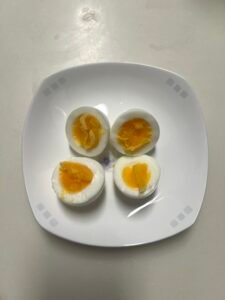
In fact, I eat two boiled eggs almost every morning.
It has become one of the simplest habits in my daily routine. I don’t need a complicated recipe or a long list of ingredients. I can boil two eggs, add a few other foods, and have breakfast ready.
Another reason I keep eating them is that eggs are affordable and easy to find. But for me, convenience is only part of the story.
I actually enjoy eating eggs.
I like them boiled, fried, steamed, and mixed with vegetables. If I miss my eggs in the morning, I can easily have them later with a salad or rice.
One of my favorite simple meals is a fried egg mixed with warm rice, a little soy sauce, and sesame oil. I wrap the rice and egg in roasted seaweed and eat it together. The combination of the warm rice, savory soy sauce, nutty sesame oil, and crispy seaweed is incredibly satisfying.
I also make vegetable omelets when I have vegetables in the refrigerator. And when I make steamed eggs, I sometimes mix the eggs with milk. The milk makes the steamed eggs softer and smoother, and I especially like the richer, nuttier flavor of the yolk.
So yes, I eat eggs because they provide protein and a variety of nutrients.
But I also eat them for a much simpler reason:
Eggs are one of the foods I never get tired of eating.
Here are five reasons they have become such a regular part of my meals.
1. Eggs Give Me an Easy Protein Source
One large egg provides about 6 grams of protein.
Because I usually eat two eggs, I get roughly 12 grams of protein from breakfast before counting the other foods on my plate.
That is one reason eggs work so well for my morning routine.
I don’t have to prepare a complicated protein dish. I can boil the eggs ahead of time and keep breakfast simple.
Eggs also contain all nine essential amino acids, which we need to get from food.
Research has also examined whole eggs in relation to muscle protein synthesis. In one small study involving young men after resistance exercise, researchers found a greater muscle protein synthesis response after whole eggs compared with egg whites providing the same amount of protein.
That doesn’t mean eating eggs by itself will build muscle.
For me, the practical takeaway is much simpler:
Eggs make it easy to include protein in an ordinary meal.
And because I already enjoy them, they are one of the easiest protein foods for me to eat consistently.
2. Two Eggs Make My Breakfast Feel More Satisfying
I also like eggs because they make breakfast feel more complete.
When breakfast is mostly bread, cereal, or another carbohydrate-based food, I sometimes feel like I need something else. Adding two eggs gives the meal a protein-rich component that makes it feel more substantial to me.
Research has also compared egg breakfasts with carbohydrate-focused breakfasts.
In one study, participants who ate an egg breakfast reported greater fullness before lunch and consumed fewer calories at lunch than when they ate a bagel breakfast.
I wouldn’t interpret that as meaning eggs are a weight-loss food.
There is a more useful lesson for everyday eating:
Including a protein food at breakfast may help a meal feel more satisfying.
That is one reason my two eggs have become such a dependable part of my morning.
3. I Don’t Skip the Yolk
I always eat the yolk.
The yolk contains many nutrients that aren’t found in the same amounts in the white, including choline.
Choline is an essential nutrient involved in normal cell function and in the production of acetylcholine, a neurotransmitter involved in memory and learning.
Eggs are one convenient food source of choline.
Research has also examined dietary choline and cognitive health. Some long-term observational research has found an association between higher intake of certain choline compounds and a lower risk of dementia.
But I think it is important to keep that finding in perspective.
An association does not prove that eating eggs prevents dementia.
I don’t eat the yolk because I expect it to protect my brain.
I eat it because the yolk contains nutrients, and I genuinely like the taste.
In fact, when I make steamed eggs, the yolk has a richer, deeper flavor that I particularly enjoy.
4. Eggs Add Lutein and Zeaxanthin to My Diet
The yolk also provides lutein and zeaxanthin, two carotenoids associated with eye health.
These compounds are found in the retina and are concentrated in the macula, which is important for central vision.
Eggs are not a replacement for vegetables. Leafy greens can provide much larger amounts of lutein and zeaxanthin.
Still, eggs can contribute to overall dietary intake.
This is one reason I like pairing eggs with vegetables rather than thinking about eggs as a complete meal by themselves.
My Vegetable Egg Combinations
I make egg dishes with whatever vegetables I have available.
I might add:
- Spinach
- Mushrooms
- Green onions
- Tomatoes
- Bell peppers
- Broccoli
Sometimes I make a vegetable omelet.
Other times I simply add vegetables to a meal with boiled eggs.
I don’t need a complicated recipe. For me, the goal is simply to make an everyday meal more varied.
5. Eggs Are So Versatile That I Never Get Bored With Them
This may be the most personal reason of all.
I can prepare eggs in so many different ways.
That keeps them from feeling like the same food every day.
Two Boiled Eggs
This is my usual breakfast.
I boil two eggs and eat them in the morning. It is quick, familiar, and requires very little effort.
Vegetable Omelet
When I have vegetables available, I mix them with eggs and make an omelet.
I like this because I can change the vegetables depending on what I have at home.
Steamed Eggs With Milk
Steamed eggs are another favorite.
I sometimes mix the eggs with milk before steaming them.
The result is soft, smooth, and almost creamy in texture, which I really enjoy.
And to me, the yolk has a deeper, nuttier flavor when I eat steamed eggs.
Fried Egg With Rice, Soy Sauce, Sesame Oil, and Seaweed
This is one of my favorite ways to eat an egg when I want something simple but especially tasty.
I fry an egg and mix it with warm rice.
Then I add a little soy sauce and sesame oil and wrap the mixture in roasted seaweed.
It is such a simple combination, but the flavor is hard for me to resist.
The sesame oil adds a nutty aroma, the soy sauce adds savory flavor, and the seaweed gives it a little crispness.
This is a good example of why I don’t think healthy eating has to be boring.
Eggs With Salad
If I don’t have time for eggs in the morning, I may add them to a salad later in the day.
It is another easy way to use the same food without making the meal feel repetitive.
Why I Keep Two Eggs as My Morning Habit
People sometimes ask why I eat two eggs.
Honestly, there isn’t a complicated reason.
Two eggs simply became my normal breakfast portion.
They give me around 12 grams of protein, are easy to prepare, and fit comfortably into the rest of my breakfast.
But I don’t think everyone needs to eat exactly two eggs every day.
A person’s nutritional needs can be very different depending on their overall diet, health history, age, activity level, and other factors.
For me, two eggs work because they fit naturally into the way I eat.
I Don’t Think One Food Needs to Do Everything
This is something I have learned from eating eggs regularly.
I don’t expect eggs to provide everything my body needs.
I use them as one part of a larger meal.
Eggs can provide protein and nutrients such as choline, lutein, and zeaxanthin, while vegetables, whole grains, fruits, nuts, and other foods provide many other nutrients.
For example, I would rather eat eggs with vegetables and another whole-food carbohydrate than turn the entire meal into an “egg-only” meal.
That makes more sense to me than searching for one perfect food.
What About Cholesterol?
There is one thing I don’t ignore: egg yolks contain dietary cholesterol.
A large egg contains roughly 186 mg of cholesterol.
However, looking at the cholesterol number in one food doesn’t tell the whole story. Overall eating patterns, saturated fat intake, fiber intake, physical activity, and individual health history all matter.
So I don’t think eggs should simply be labeled “good” or “bad.”
I eat them regularly because they fit well into my overall eating pattern.
But someone with high cholesterol, cardiovascular disease, diabetes, or specific dietary restrictions may need different advice.
If you have been told to limit dietary cholesterol or are taking medication related to cholesterol or cardiovascular health, it is better to discuss your individual egg intake with your doctor or registered dietitian.
What I Like Most About Eggs
After eating eggs so regularly, I think the biggest advantage is not one particular nutrient.
It is how easy they are to keep in my life.
I can boil them.
I can fry them.
I can steam them.
I can mix them with vegetables.
I can add them to a salad.
I can mix a fried egg into warm rice with soy sauce and sesame oil and wrap it in seaweed.
And I can change the texture and flavor depending on how I cook them.
That variety is probably why I have never gotten tired of eating them.
My Bottom Line
I eat two boiled eggs almost every morning.
Not because I think eggs are a miracle food, and not because I expect them to prevent every health problem.
I eat them because they are affordable, convenient, nutritious, versatile, and genuinely delicious to me.
The research gives me additional reasons to appreciate them. Eggs provide protein and nutrients such as choline, lutein, and zeaxanthin, and they can fit easily into a balanced eating pattern.
But my favorite part is still the simplest:
I really like eggs.
Whether they are boiled for breakfast, mixed with vegetables in an omelet, steamed with milk, added to a salad, or mixed into warm rice with soy sauce, sesame oil, and seaweed, eggs are one food I never seem to get tired of.
And that is why they continue to show up on my table almost every day.
Health note: This article is for general nutrition information and is not medical advice. Individual dietary needs vary. If you have high cholesterol, cardiovascular disease, diabetes, or another medical condition that affects your diet, talk with a qualified healthcare professional about your individual egg intake.