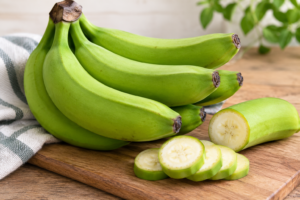
Have you ever seen a green banana and wondered why it looks so different from the soft, sweet yellow bananas we usually eat?
Green bananas are not a special variety. They are simply bananas that have not fully ripened. One of the biggest differences between green and ripe bananas is the type of carbohydrate they contain.
Green bananas contain more resistant starch, a type of carbohydrate that is not easily digested in the small intestine. Because some resistant starch can reach the large intestine, it has attracted attention for its possible connection to blood sugar response and gut health.
I have never actually eaten a green banana myself, although I have seen them on TV many times. I have heard that baking green bananas makes them sweeter and gives them a taste and texture somewhat similar to sweet potatoes.
I had not paid much attention to green bananas before, but after learning more about resistant starch and its potential connection to gut health and blood sugar, I think I should finally give them a try. I sometimes have difficulty having a regular bowel movement, so I am especially curious to see how my body responds.
What Makes Green Bananas Different?
The main difference between green and ripe bananas is what happens to their starch as they ripen.
A green banana is firm, less sweet, and contains more starch. As the banana ripens, some of that starch is gradually broken down into simpler sugars. This is why a yellow banana becomes softer and sweeter.
Green bananas contain a significant amount of type 2 resistant starch (RS2). Because of its structure, resistant starch is not completely broken down by digestive enzymes in the small intestine.
Instead, some of it can pass through the small intestine without being fully digested.
This is what makes green bananas different from many other carbohydrate-rich foods.
What Is Resistant Starch?
Resistant starch is a type of starch that resists digestion in the small intestine.
Most ordinary starch is broken down into glucose and absorbed in the small intestine. Resistant starch behaves differently because part of it escapes digestion and can reach the large intestine.
Although resistant starch is technically a carbohydrate, it can have some physiological characteristics similar to dietary fiber.
Green bananas are one natural source of resistant starch. Other foods, including beans, oats, and some cooked-and-cooled starchy foods, can also provide resistant starch.
The amount found in green bananas can vary depending on the banana variety, ripeness, processing, and cooking method.
For example, research on green banana flour has found relatively high levels of resistant starch in some products, but these numbers should not be applied to every green banana or green banana flour product.
Green Bananas and Blood Sugar
One reason green bananas have attracted attention is their potential effect on blood sugar response.
Because resistant starch is not digested in the same way as ordinary starch, some of it does not immediately become glucose in the small intestine.
This may result in a different blood sugar response compared with foods containing more rapidly digestible starch.
Research on resistant starch has examined several measures related to glucose metabolism and insulin sensitivity. Some studies and reviews have reported improvements in certain blood sugar-related measures after resistant starch consumption.
However, this does not mean that green bananas directly lower blood sugar or treat diabetes.
Green bananas still contain carbohydrates, and your overall meal, portion size, activity level, and individual metabolism can all influence your blood sugar response.
For someone paying attention to blood sugar, it may be more useful to think of green bananas as one carbohydrate-containing food with a higher amount of resistant starch rather than as a blood-sugar-lowering food.
What Research Says About Green Bananas
Research has also looked specifically at green banana products.
In one randomized controlled trial involving adults with prediabetes or type 2 diabetes, participants consumed green banana biomass as part of a nutritional intervention for 24 weeks. Researchers observed changes in some measures related to glucose and insulin metabolism and body composition.
Other research has reviewed clinical studies involving green banana flour, fruit, and biomass. These studies have explored areas including blood sugar, insulin metabolism, bowel function, and body weight.
The results are interesting, but the studies have used different forms and amounts of green banana. Because of this, there is not currently one standard amount of green banana that can be recommended for everyone.
More research is needed to understand how different green banana products and serving sizes affect different people.
Green Bananas and Gut Health
The connection between green bananas and gut health is largely related to resistant starch.
Some resistant starch passes through the small intestine and reaches the large intestine. There, gut microbes can ferment it.
During fermentation, gut bacteria can produce short-chain fatty acids (SCFAs) such as acetate, propionate, and butyrate.
Butyrate is particularly interesting because cells lining the colon can use it as an energy source.
Research on resistant starch has also examined changes in gut microbial populations and fermentation products.
This does not mean that eating green bananas will improve everyone’s digestion in exactly the same way. Everyone’s gut microbiome is different, and some people may be more sensitive to fermentable carbohydrates than others.
Still, the resistant starch in green bananas makes them an interesting food for people who want to include different types of fiber and fermentable carbohydrates in their diet.
Green Bananas vs. Yellow Bananas
The color of a banana can tell you something about its ripeness.
Green bananas
- Firmer texture
- Less sweet
- Higher in resistant starch
- More difficult to eat raw
- Often used cooked or as green banana flour
Yellow ripe bananas
- Softer texture
- Sweeter taste
- More of the starch has been converted into sugars
- Easier to eat as a snack
- Convenient for smoothies, yogurt, or oatmeal
Neither one needs to be considered “good” or “bad.” They simply have different characteristics.
If your main interest is resistant starch, a less-ripe green banana generally contains more resistant starch than a fully ripe banana.
Can Green Bananas Help With Regularity?
Because resistant starch can reach the large intestine and be fermented by gut microbes, green bananas may be interesting for people who want to increase certain types of fermentable carbohydrates in their diet.
However, having a bowel movement is influenced by much more than one food.
Overall fiber intake, fluid intake, physical activity, eating patterns, medications, and individual digestive habits can all affect bowel regularity.
If you sometimes have difficulty going to the bathroom, adding a variety of fiber-rich foods gradually may be more practical than depending on one food.
How to Eat Green Bananas
Green bananas are quite different from ripe bananas, so you may want to cook them rather than eat them raw.
Here are some simple options:
Bake Them
Baking can soften green bananas and bring out a sweeter flavor. This is actually the way I have heard about most often on TV, and I am curious to try it myself.
Boil or Steam Them
Green bananas can be boiled or steamed until tender and served as a side dish, somewhat like other starchy vegetables.
Try Green Banana Flour
Green banana flour can be mixed into oatmeal, porridge, yogurt, or homemade baked goods.
Start with a small amount because the resistant starch can be fermented by gut bacteria.
Add Them to a Balanced Breakfast
If you are using green banana flour, you could combine a small amount with foods such as plain Greek yogurt, berries, chia seeds, or nuts.
This gives you a breakfast that includes different sources of protein, fiber, and healthy fats rather than relying on one ingredient.
Start Slowly
If you are not used to eating foods rich in resistant starch, suddenly adding a large amount may cause gas, bloating, or abdominal discomfort.
This happens because gut bacteria ferment resistant starch in the large intestine.
A simple approach is to start with a small amount and gradually increase it if you tolerate it well.
Also remember that more resistant starch is not automatically better. The goal is to find an amount that fits comfortably into your overall diet.
My Simple Breakfast Habits
I usually prefer simple breakfasts rather than trying to add too many ingredients at once.
Plain Greek yogurt with berries and a few nuts is one combination I enjoy. I also like oatmeal with berries and ground flaxseed.
Because I sometimes have difficulty with regular bowel movements, I pay attention to how much fiber I am eating and try to drink enough water throughout the day.
I have not tried green bananas yet, but learning about their resistant starch has made me interested in giving them a chance.
I especially want to try baking them because I have heard they can become sweeter and taste somewhat like sweet potatoes.
I think this is a good reminder that healthy eating does not always have to mean eating the same foods every day. Trying different fiber-rich foods can make a healthy diet more interesting and easier to maintain.
Green Bananas Are Not the Only Source of Resistant Starch
Green bananas are just one option.
Beans, oats, legumes, and some cooked-and-cooled starchy foods can also provide resistant starch or other types of dietary fiber.
If you are also interested in other foods that can fit into a blood-sugar-conscious diet, see 4 Foods for Better Blood Sugar Control
Rather than focusing on one “healthy” food, it can be more useful to include a variety of whole and minimally processed foods throughout the day.
What to Keep in Mind
Green bananas can be an interesting addition to a balanced diet, but they are not a miracle food.
Keep these points in mind:
- Green bananas contain carbohydrates.
- Their resistant starch content is higher when they are less ripe.
- Ripening changes the starch into more readily available sugars.
- Cooking and processing can change resistant starch content.
- Green banana flour products can vary.
- Large amounts may cause gas or bloating in some people.
- Individual blood sugar responses can vary.
If you have diabetes, prediabetes, or digestive problems, consider your individual needs and discuss major dietary changes with your healthcare professional.
Frequently Asked Questions
Are green bananas healthier than ripe bananas?
Not necessarily. Green and ripe bananas have different nutritional characteristics. Green bananas contain more resistant starch, while ripe bananas are softer and sweeter.
Do green bananas lower blood sugar?
Green bananas should not be considered a blood-sugar-lowering treatment. Their higher resistant starch content may influence how some of their carbohydrate is digested and may affect blood sugar response.
Are green bananas good for gut health?
Their resistant starch can reach the large intestine, where gut microbes can ferment it. This is one reason green bananas are being studied in relation to gut health.
Can I eat green bananas every day?
Some people may tolerate them well, while others may experience gas or bloating. If you are new to resistant starch, starting with a small amount is a reasonable approach.
Is green banana flour the same as a green banana?
Not exactly. Processing can change the composition of the food, and different products can contain different amounts of resistant starch and fiber. Check the nutrition label when choosing green banana flour.
Bottom Line
Green bananas are simply unripe bananas, but their higher resistant starch content gives them some interesting nutritional characteristics.
Resistant starch is not completely digested in the small intestine. Some can reach the large intestine, where gut microbes ferment it and produce short-chain fatty acids.
This is why green bananas have attracted interest in both blood sugar and gut health research.
I have never tried green bananas before, but after learning more about them, I am interested in trying them baked. Since I sometimes have difficulty with regular bowel movements, I am particularly curious to see how my body responds.
For now, I think of green bananas as one more food worth exploring—not as a treatment, but as a possible way to add resistant starch to a varied, balanced diet.
Health Note
This article is for general nutrition information and is not medical advice. Green bananas do not treat or cure diabetes, constipation, or other medical conditions. If you have diabetes, prediabetes, persistent constipation, or digestive symptoms, talk with a qualified healthcare professional about your individual diet and treatment needs.