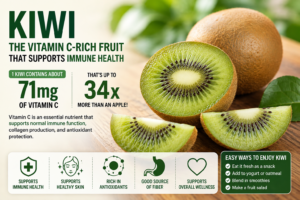
When you think about vitamin C, oranges may be the first fruit that comes to mind. But kiwi is another simple and nutritious way to get this important vitamin.
One medium green kiwi provides about 64 mg of vitamin C, which is about 71% of the Daily Value for vitamin C. The exact amount can vary depending on the size and variety of the kiwi.
Kiwi also provides fiber, vitamin E, folate, potassium, and other nutrients. You can eat it by itself or add it to yogurt, oatmeal, or a simple fruit bowl.
So, how much vitamin C is actually in one kiwi, and what else does this small fruit provide?
How Much Vitamin C Is in One Kiwi?
A medium kiwi contains about 64 mg of vitamin C.
For comparison, the recommended daily amount of vitamin C for most adults is 90 mg for men and 75 mg for women. This means one medium kiwi can provide a substantial amount of the vitamin C an adult needs in a day.
However, the amount is not exactly the same in every kiwi. Fruit size, variety, ripeness, growing conditions, and storage can affect the nutritional content.
This is why it is better to think of the 64 mg figure as a useful reference rather than an exact number for every kiwi you eat.
Vitamin C in One Kiwi at a Glance
- 1 medium kiwi: about 64 mg vitamin C
- Adult men: 90 mg recommended daily amount
- Adult women: 75 mg recommended daily amount
- Vitamin C Daily Value: 90 mg for adults and children age 4 and older
Kiwi is therefore a convenient whole-food source of vitamin C.
Why Is Vitamin C Important?
Vitamin C is a water-soluble vitamin that your body needs from food or other sources.
It has several important roles in normal body function.
Vitamin C Supports Normal Immune Function
Vitamin C contributes to normal immune system function.
However, this does not mean eating one kiwi will prevent you from getting sick. A healthy immune system depends on many factors, including overall nutrition, sleep, physical activity, and general health.
Kiwi can simply be one nutritious food that contributes vitamin C to your diet.
Vitamin C Helps Make Collagen
Your body needs vitamin C to make collagen.
Collagen is an important protein found in the skin, bones, cartilage, and connective tissues.
Eating foods that provide vitamin C, such as kiwi, strawberries, oranges, peppers, and broccoli, can help you get the vitamin C your body needs for normal collagen production.
Vitamin C Helps With Iron Absorption
Vitamin C also helps your body absorb iron from plant-based foods.
For example, you could combine a vitamin-C-rich fruit such as kiwi with foods such as beans, lentils, or spinach.
This is one reason it can be useful to think about how different foods work together rather than focusing on one food by itself.
Kiwi Nutrition: What Else Does It Provide?
Vitamin C is one of the best-known nutrients in kiwi, but it is not the only reason this fruit can be part of a healthy diet.
1. Fiber
Kiwi provides dietary fiber, which is important for normal digestive health.
Eating whole kiwi instead of drinking kiwi juice also allows you to keep the fruit’s natural fiber.
Fiber is an important part of a balanced eating pattern and can also contribute to feelings of fullness.
2. Vitamin E
Kiwi contains vitamin E, another nutrient involved in protecting cells from oxidative damage.
Eating a variety of fruits, vegetables, nuts, seeds, and other minimally processed foods is a practical way to obtain different nutrients rather than depending on one food.
3. Folate
Kiwi provides folate, a B vitamin that plays a role in normal cell division and other important functions.
Kiwi is not the only source of folate, but it can contribute to your overall intake.
4. Potassium
Kiwi also provides potassium, a mineral involved in normal nerve function, muscle function, and fluid balance.
Again, the goal is not to get all of your nutrients from one fruit. Variety is more important.
Kiwi vs. Orange: Which Has More Vitamin C?
Both kiwi and oranges are well-known sources of vitamin C.
A medium kiwi provides about 64 mg of vitamin C, while a medium orange provides about 70 mg according to the NIH vitamin C fact sheet.
So, an orange provides slightly more vitamin C by the serving sizes listed in that comparison.
But that does not mean one fruit is always better than the other.
Kiwi
Kiwi provides vitamin C along with fiber, vitamin E, folate, and potassium.
It is also small, easy to prepare, and can be eaten with a spoon after cutting it in half.
Orange
Oranges provide vitamin C and fiber when eaten as a whole fruit.
They can be eaten as a snack, added to a salad, or enjoyed alongside breakfast.
One important difference is that whole fruit and fruit juice are not exactly the same. Eating a whole orange provides the fruit’s natural fiber, while juice is easier to drink quickly and may contain less fiber.
Which One Should You Choose?
You do not have to choose only one.
Kiwi and oranges can both fit into a healthy eating pattern.
If you enjoy kiwi, it can be an easy way to add vitamin C and fiber to your diet. If you prefer oranges, they are another nutritious choice.
The best fruit is often the one you enjoy and can eat regularly as part of a varied diet.
What Are the Potential Benefits of Eating Kiwi?
Kiwi can be a useful addition to a balanced diet for several simple reasons.
It Provides Vitamin C
If you do not regularly eat many vitamin-C-rich foods, adding kiwi can be an easy way to increase your vitamin C intake.
One medium kiwi provides a substantial amount of vitamin C without requiring much preparation.
It Provides Fiber
Because kiwi is a whole fruit, it provides dietary fiber.
If you are trying to eat more fiber, kiwi can be combined with other fiber-rich foods such as oats, berries, chia seeds, beans, and whole grains.
It Adds Variety to Your Diet
Healthy eating does not have to mean eating the same fruit every day.
Adding different fruits gives you different flavors, textures, and nutrients.
Kiwi can be one simple way to add more variety.
Can Eating One Kiwi a Day Improve Your Health?
Eating one kiwi every day can be a nutritious habit, but it should not be viewed as a magic formula.
If you enjoy kiwi and it fits comfortably into your diet, eating it regularly can help you get vitamin C, fiber, and other nutrients.
But there is no requirement to eat exactly one kiwi every day.
Some days you might choose strawberries. Other days you might eat an orange, apple, pear, or another fruit.
The bigger goal is to build a varied eating pattern over time.
Is Kiwi Good for Immune Health?
Kiwi provides vitamin C, which contributes to normal immune system function.
However, it is more accurate to say that kiwi provides nutrients that support normal immune function rather than saying that kiwi “boosts your immune system” or prevents illness.
Your immune system is complex and depends on many nutrients and lifestyle factors.
A healthy eating pattern that includes a variety of fruits and vegetables is more important than relying on one particular food.
Can Kiwi Support Digestive Health?
Kiwi contains dietary fiber, which makes it a useful addition to a balanced diet.
Some research has also examined kiwi and digestive function, including bowel regularity. However, individual responses can vary.
If you are increasing your fiber intake, it is generally helpful to increase fiber gradually and drink enough fluids.
You can enjoy kiwi by itself or combine it with other fiber-rich foods such as oats, berries, chia seeds, and whole grains.
When Is the Best Time to Eat Kiwi?
There is no universally established “best” time to eat kiwi.
You can enjoy it:
- With breakfast
- As an afternoon snack
- With plain Greek yogurt
- Over oatmeal
- In a fruit salad
- Alongside a meal
- In a smoothie
There is no universally established “best” time to eat kiwi.
You can enjoy it:
- With breakfast
- As an afternoon snack
- With plain Greek yogurt
- Over oatmeal
- In a fruit salad
- Alongside a meal
- In a smoothie
If you enjoy fruit in the morning, you can also explore 7 Low-Sugar Fruits for Morning Snacks for more simple fruit ideas.
What matters more is your overall eating pattern.
For example, sliced kiwi with plain Greek yogurt, berries, and a few walnuts can make a simple and balanced breakfast.
Easy Ways to Add Kiwi to Your Diet
You do not need a complicated recipe to enjoy kiwi.
Kiwi and Greek Yogurt
Slice one kiwi and add it to plain Greek yogurt.
You can also add berries and a few walnuts for more texture and variety. For more ideas on foods that pair well with fruit, see 7 Healthy Foods to Pair With Fruit.
Kiwi and Oatmeal
Add sliced kiwi to cooked oatmeal after it has cooled slightly.
You can also add chia seeds, walnuts, or other fruit.
Simple Fruit Salad
Combine kiwi with strawberries, blueberries, oranges, or other fruits you enjoy.
This is an easy way to eat several types of fruit in one meal.
Kiwi Smoothie
Blend kiwi with plain yogurt, berries, and milk or an unsweetened milk alternative.
If you are making a smoothie, using whole fruit rather than fruit juice can help you keep more of the fruit’s natural fiber.
Simple Snack
Sometimes the easiest option is the best one.
Cut a kiwi in half and scoop out the fruit with a spoon.
There is no need to turn every healthy food into a complicated recipe.
How to Choose and Store Kiwi
When choosing kiwi, look for fruit without major bruises or damaged areas.
A ripe kiwi should have a little give when you gently press it. If it is very firm, it may need more time to ripen.
You can leave firm kiwi at room temperature for a few days until it reaches the ripeness you prefer.
Once ripe, you can refrigerate it to help maintain its quality.
Buying kiwi at different stages of ripeness can also make it easier to keep fresh fruit available throughout the week.
Should You Eat Kiwi With or Without the Skin?
The skin of green kiwi is edible and contains additional fiber and nutrients.
However, the fuzzy texture is not appealing to everyone.
If you do not enjoy the skin, there is nothing wrong with peeling the kiwi and eating the fruit inside.
Either way, wash fresh kiwi thoroughly before eating.
Golden kiwi varieties generally have smoother skin and may be easier to eat with the skin if you prefer that option.
How Many Kiwis Should You Eat a Day?
There is no universal requirement to eat a specific number of kiwis every day.
For many people, one or two kiwis can fit comfortably into a balanced diet.
However, the appropriate amount depends on your overall diet, nutritional needs, and personal preferences.
You also do not need to force yourself to eat kiwi if you do not enjoy it.
Other fruits can provide vitamin C, fiber, and other important nutrients.
The goal is variety rather than relying on one “superfood.”
My Experience With Eating Kiwi
I started eating kiwi more often because it was an easy way to add another fruit to my daily meals.
I usually have it in the morning, either by itself or sliced into plain yogurt with some berries and nuts.
What I like most about kiwi is that it does not take much time to prepare. I can simply cut it in half and eat it with a spoon, or slice it and add it to breakfast.
I also enjoy its fresh, slightly sweet and tangy flavor. When I have kiwi in the refrigerator, it is an easy choice when I want something fresh instead of a packaged snack.
I do not expect one fruit to make a dramatic difference in my health. Instead, I try to look at kiwi as one small part of an overall healthy eating routine.
For me, the biggest benefit is simply that kiwi is an easy, nutritious food that I actually enjoy eating regularly.
Who Should Be Careful With Kiwi?
Most people can enjoy kiwi as part of a normal diet, but kiwi can cause allergic reactions in some people.
Possible symptoms may include itching or tingling in the mouth, swelling of the lips or throat, hives, or other allergic symptoms.
If you experience symptoms of an allergic reaction after eating kiwi, stop eating it and seek appropriate medical advice. Severe allergic symptoms require urgent medical attention.
People who have been told by a healthcare professional to follow a specific diet should also consider their individual nutritional needs.
Frequently Asked Questions
Is kiwi high in vitamin C?
Yes. One medium kiwi provides about 64 mg of vitamin C, making it a useful whole-food source of this nutrient.
Is kiwi healthier than an orange?
Neither fruit needs to be considered universally healthier. A medium kiwi provides about 64 mg of vitamin C, while a medium orange provides about 70 mg. Both can be nutritious choices.
Can I eat kiwi every day?
For most people, kiwi can be included regularly as part of a balanced diet if they enjoy it and tolerate it well. There is no requirement to eat it every day.
Does kiwi help digestion?
Kiwi provides dietary fiber and can be part of a diet that supports normal digestive health. Some research has also examined kiwi and bowel regularity, but individual responses can differ.
Is kiwi good for your immune system?
Kiwi provides vitamin C, which contributes to normal immune function. However, eating kiwi does not guarantee protection from illness.
Is kiwi better in the morning?
There is no universally established best time to eat kiwi. You can enjoy it at breakfast, as a snack, or with another meal.
Is it okay to eat kiwi skin?
Yes. Kiwi skin is edible, although some people do not like its texture. Wash the fruit thoroughly before eating it.
Final Thoughts
Kiwi is a small fruit with a useful combination of nutrients.
Most notably, one medium kiwi provides about 64 mg of vitamin C, along with fiber, vitamin E, folate, potassium, and other nutrients.
It can be eaten by itself or added to plain yogurt, oatmeal, fruit salads, or smoothies.
At the same time, there is no need to treat kiwi as a miracle food.
Healthy eating is not about finding one perfect fruit. It is about building a varied diet that includes fruits, vegetables, whole grains, beans, nuts, seeds, protein-rich foods, and other nutritious choices.
If you enjoy kiwi, eating it regularly can be a simple and enjoyable way to add more fruit and vitamin C to your diet.
Health Note
This article is for general educational purposes only and is not intended to diagnose, treat, or prevent any medical condition. If you have a food allergy, a medical condition, or specific dietary concerns, talk with your healthcare professional about the foods and portion sizes that are appropriate for you.
Sources
- National Institutes of Health, Office of Dietary Supplements — Vitamin C Fact Sheet
- U.S. Department of Agriculture FoodData Central — Food and nutrient information
Important: This article provides general health imformation and is not a substitute for individualized medical advice. If you have a medical condition or sprcific dietary or exercise needs, consult a qualified healthcare professional.