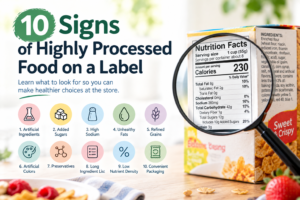
When I go grocery shopping, I used to look at the front of the package first.
Words like “healthy,” “natural,” “multigrain,” or “made with real ingredients” often caught my attention. But after I started paying more attention to food labels, I realized that the front of the package does not always tell the whole story.
The ingredient list and Nutrition Facts label can tell you much more.
You don’t have to understand every ingredient or spend ten minutes reading every package. I usually start by looking at a few simple things: the first ingredients, added sugar, refined grains, oils, additives, and serving size.
These simple checks can help you spot signs of highly processed food and make more informed choices when shopping.
What Does “Highly Processed” Really Mean?
Not all processed food is unhealthy.
This is important to understand before looking closely at food labels.
Many foods go through some type of processing. Frozen vegetables, canned beans, plain yogurt, oats, and whole-grain bread are examples of foods that may be processed in simple ways.
Processing itself is not automatically a bad thing.
The concern is more about foods that are highly formulated and contain combinations of refined ingredients, added sugars, oils, flavors, colors, and other additives.
Examples can include some packaged snacks, sugary breakfast cereals, candy, sweetened drinks, and certain ready-to-eat meals.
Instead of asking, “Is this food processed or not?” I find it more useful to ask:
How much processing has gone into this food, and what ingredients were added?
That question gives you a better starting point.
1. The First Few Ingredients Are Refined Ingredients
The beginning of the ingredient list is one of the first places I look.
Ingredients are generally listed by weight, with the ingredients used in the greatest amounts appearing first. This means the first several ingredients can give you a useful idea of what makes up most of the product.
For example, if refined flour, sugar, or another refined ingredient appears near the beginning of the list, I pay closer attention.
When comparing similar products, I often look at the first three to five ingredients.
If one product starts with recognizable foods such as whole grains, nuts, or beans while another starts with refined flour and several sweeteners, I may choose the first option.
The first ingredients do not tell you everything, but they are a useful place to start.
2. Added Sugar Appears High on the Ingredient List
Added sugar is another thing I check carefully.
Sugar can appear under different names, including:
- Sugar
- Cane sugar
- Brown sugar
- Corn syrup
- Honey
- Molasses
- Dextrose
- Glucose syrup
- Fructose
Seeing one of these ingredients does not automatically make a food unhealthy.
However, if an added sweetener appears near the beginning of the ingredient list, I also check the Added Sugars line on the Nutrition Facts label.
The Nutrition Facts label tells you how much added sugar is in a serving, while the ingredient list helps you identify the sources of that sweetness.
I find it especially helpful when comparing breakfast cereals, granola bars, flavored yogurt, breads, sauces, and snacks.
3. Several Different Sweeteners Are Used
Sometimes a product does not have just one type of sweetener.
You may find several different sweetening ingredients in the same product.
For example, a packaged food might contain sugar along with syrup, molasses, or another sweetener.
This does not mean that every ingredient is harmful. Instead, it gives me a reason to look more closely at the product’s overall nutrition.
I ask:
How much added sugar does one serving contain?
I also check the serving size because the amount listed on the Nutrition Facts label applies to the stated serving.
If I eat two servings, I consume twice the amount of added sugar, sodium, calories, and other nutrients listed per serving.
4. Refined Grains Are the Main Ingredients
Another clue I look for is the type of grain used.
Words such as “whole grain” or “multigrain” on the front of a package can sound appealing, but I prefer to check the ingredient list myself.
For bread, cereal, crackers, and similar products, look at which grain ingredients appear first.
A product made primarily with whole grains can be different from one made mostly with refined flour and only a small amount of whole grain.
This is one reason I turn the package around instead of relying only on the front label.
When I buy bread, I usually check the ingredient list before making my decision.
5. Many Different Oils Are Added
Some highly formulated foods contain several types of added oils.
You may see ingredients such as:
- Soybean oil
- Canola oil
- Corn oil
- Sunflower oil
- Palm oil
The presence of oil does not automatically mean that a food is unhealthy. Oils are normal ingredients in many foods.
What catches my attention is when several oils appear together with refined grains, added sugars, flavors, colors, and other ingredients.
Rather than judging one ingredient by itself, I look at the entire ingredient list and Nutrition Facts label.
6. The Product Contains Many Flavors, Colors, or Other Additives
Highly formulated packaged foods may contain ingredients added to create flavor, color, texture, consistency, or shelf life.
Examples can include:
- Artificial colors
- Added flavors
- Preservatives
- Emulsifiers
- Stabilizers
- Thickeners
- Other food additives
An unfamiliar ingredient or a technical-sounding name does not automatically mean that a food is unsafe or unhealthy.
Some additives have practical purposes and are used to help preserve food or maintain its texture.
Instead of being afraid of one difficult-to-pronounce ingredient, I look at the overall pattern.
If a product contains a long combination of refined ingredients, sweeteners, oils, flavors, colors, and other additions, I may compare it with a simpler alternative.
7. The Ingredient List Is Very Long and Complicated
A very long ingredient list can be another reason to take a closer look.
But length alone does not determine whether a food is healthy or unhealthy.
For example, some whole-grain breads may contain several ingredients because they include seeds, oils, preservatives, or added nutrients.
What matters is what those ingredients are.
When I see a long list, I ask:
- What are the first few ingredients?
- Are there several added sweeteners?
- Are refined grains prominent?
- Are there many flavors, colors, or other additives?
- What does the Nutrition Facts label show?
This approach is more useful than simply counting the number of ingredients.
8. The Food Is Very Different From Its Original Form
One of the simplest questions you can ask is:
How close is this food to its original form?
Consider plain oats.
The ingredient list may simply say:
Whole grain oats
Now compare that with a flavored instant oatmeal product that contains oats along with sugar, sweeteners, flavorings, oils, and other ingredients.
Both are convenient foods, but they are clearly different products.
The same idea can be applied to many packaged foods.
You do not have to avoid foods simply because they have been processed. Instead, consider how much has been added or changed from the original food.
9. The Package Makes Health Claims That Do Not Match the Ingredient List
This is one of the biggest lessons I have learned from reading food labels.
A package may prominently say:
- Natural
- Multigrain
- Made with real ingredients
- Healthy
- Low fat
- Whole grain
These words can provide useful information, but they do not tell you the entire nutritional story.
A product can have an appealing health-related message on the front while still containing added sugars, refined ingredients, or other components you may not want to eat frequently.
That is why I now turn the package around and read the back.
The ingredient list and Nutrition Facts label give me more information than the front of the package alone.
10. A Similar Product Has a Simpler Ingredient List
Sometimes the easiest way to recognize a highly formulated food is not to judge it by itself.
Compare it with a similar product.
For example, if you are buying peanut butter, compare two jars.
Look at:
- Ingredient list
- Added sugar
- Sodium
- Serving size
- Protein
- Fiber
You can use the same approach when comparing:
- Bread
- Breakfast cereal
- Crackers
- Yogurt
- Granola
- Pasta sauce
- Snack bars
You may find that one product has a much simpler ingredient list or a nutritional profile that better fits your usual eating habits.
Comparing similar products is often easier than trying to memorize a long list of ingredients to avoid.
How I Read a Food Label at the Grocery Store
I do not try to memorize every food additive or ingredient name.
Instead, I use a simple routine.
First, I look at the ingredient list.
I start with the first three to five ingredients because they tell me what makes up much of the product.
Second, I look for added sugars.
I check both the ingredient list and the Added Sugars line on the Nutrition Facts label.
Third, I check sodium.
Some packaged foods may contain more sodium than I expect, even when they do not taste extremely salty.
Fourth, I look at fiber and protein.
These numbers can help me understand the nutritional value of the food.
Finally, I compare similar products.
If two products are similar, I can often find a better fit simply by comparing their labels.
This takes less time than trying to research every ingredient individually.
Why I Check Sodium Too
Added sugar gets a lot of attention, but sodium is also worth checking.
Packaged foods such as sauces, soups, frozen meals, canned foods, snack foods, and prepared meals can contain significant amounts of sodium.
You do not need to avoid sodium completely. Sodium is an essential nutrient.
The goal is simply to be aware of how much you are getting, especially if packaged foods make up a large part of your diet.
When I compare similar products, I usually check sodium along with added sugar.
What About Frozen and Canned Foods?
Frozen and canned foods are not automatically highly processed.
For example, some frozen vegetables contain nothing more than the vegetable itself.
Canned beans may contain beans, water, and salt.
These foods can be convenient and useful to keep at home.
Frozen fruits and vegetables can also be practical when fresh produce is unavailable or when you want to reduce food waste.
The important thing is to read the label rather than judge the food simply because it comes in a package.
Don’t Be Afraid of Every Unfamiliar Ingredient
Food labels can sometimes look intimidating.
You may see a long scientific name and immediately think that the ingredient must be bad.
I do not think that is a useful rule.
Some ingredients have complicated names but are used for practical purposes such as preserving food, improving texture, or keeping ingredients from separating.
An ingredient that you cannot pronounce does not automatically make a food unhealthy.
Instead, consider the entire product.
Look at the ingredient list, Nutrition Facts label, serving size, and how often you eat the food.
My Simple Shopping Habit
I used to decide what to buy based mostly on the front of the package.
Now I usually turn the package around and read the ingredient list first.
For snacks, I often compare a few similar products before choosing one.
If I have a choice, I may choose foods such as plain yogurt, walnuts, pistachios, fruit, or other simple foods instead of automatically reaching for cookies, chips, or heavily flavored snacks.
I do not try to make every food choice perfect.
There are days when a packaged food is simply more convenient, and that is okay.
For me, the goal is to make better choices more often rather than trying to follow a perfect diet.
A Simple Five-Step Label Check
If reading food labels feels overwhelming, start with these five steps:
Step 1: Read the Ingredient List
Turn the package around and look at the ingredients.
Step 2: Check the First Three to Five Ingredients
See what makes up most of the product.
Step 3: Look for Added Sugars
Check both the ingredient list and the Added Sugars line.
Step 4: Check Sodium, Fiber, and Protein
These numbers can help you compare similar products.
Step 5: Compare Another Product
You do not have to decide whether one food is simply “good” or “bad.”
Compare two similar products and choose the one that better fits your eating habits.
Are All Processed Foods Unhealthy?
No.
This is an important distinction.
Processing can make food safer, more convenient, or easier to store.
Foods such as frozen vegetables, canned beans, plain yogurt, oats, and some whole-grain breads can all be processed while still being useful parts of a balanced diet.
The goal is not to eliminate all processed foods.
Instead, learning how to read an ingredient list can help you recognize highly formulated products and make more informed choices.
Frequently Asked Questions
How can I tell if a food is highly processed?
Start by looking at the ingredient list. Check the first few ingredients, added sugars, refined grains, oils, flavors, colors, and other additives. Then look at the Nutrition Facts label and compare similar products.
Does a long ingredient list mean a food is highly processed?
Not necessarily. A long ingredient list by itself does not determine whether a food is healthy or unhealthy. Look at the types of ingredients and the overall nutritional profile.
Should I avoid ingredients I cannot pronounce?
No. An unfamiliar or scientific-sounding ingredient does not automatically mean that a food is unhealthy. Consider the entire ingredient list instead.
Is “natural” always healthier?
Not necessarily. Words such as “natural” or “made with real ingredients” do not tell you everything about a product. Checking the ingredient list and Nutrition Facts label gives you more useful information.
Are frozen vegetables highly processed?
Not necessarily. Some frozen vegetables contain only the vegetable itself. Check the ingredient list to see what has been added.
Is every packaged food unhealthy?
No. Many packaged foods can be convenient and nutritious. The important thing is to look beyond the front of the package and check the ingredients and nutrition information.
What should I look at first on a food label?
I usually start with the ingredient list and the first three to five ingredients. Then I check added sugar, sodium, serving size, fiber, and protein.
Final Thoughts
Learning how to recognize highly processed foods by reading the ingredient list does not have to be difficult.
You do not need to memorize hundreds of ingredients or completely stop buying packaged foods.
Start with the basics.
Look at the first few ingredients. Check for added sugars and refined grains. Notice whether several sweeteners, oils, flavors, colors, or other additives are included. Then compare similar products instead of relying only on the health claims printed on the front of the package.
Most importantly, do not feel that you have to eat perfectly.
A healthier eating pattern can come from making small, realistic choices over and over again.
The next time you are grocery shopping, turn the package around before putting it in your cart. You may be surprised by what you find.
Sources
- U.S. Food and Drug Administration (FDA) — Nutrition Facts Label and food labeling information
- USDA FoodData Central — Food and nutrition data
- Harvard T.H. Chan School of Public Health — The Nutrition Source
Health Note
This article is for general educational purposes and is not a substitute for individualized medical or nutrition advice. If you have a medical condition or specific dietary needs, talk with a qualified healthcare professional or registered dietitian.